
REACH, RoHS, circular economy and regulatory product assessment from a single system
Manufacturers and importers of technical products must simultaneously master substance compliance, circular economy principles, PCF data, and CE requirements. Much of the information required for this is already present in the ERP system, but not in the structure required by laws, processes, and authorities.
Zusammenfassung
Produkt-Compliance entwickelt sich für den Mittelstand von einer Sammlung einzelner Pflichten zu einer komplexen, systemischen Steuerungsaufgabe. Um regulatorische Anforderungen wie REACH oder RoHS effizient zu bewältigen, bedarf es einer systematischen Datenstruktur und spezialisierter Softwarelösungen. Nur so lassen sich Materialrisiken und Nachhaltigkeitsaspekte zuverlässig steuern.
Diese Zusammenfassung wurde mit KI-Unterstützung erstellt.
Product Compliance in SMEs: Why Individual Obligations Have Long Become a Systemic Issue
From the outside, product compliance often looks like a collection of individual obligations. Information on REACH here, a classification for WEEE there, and in another place, the first requirements regarding the Product Carbon Footprint. In practice, however, a different picture emerges: what looks like separate topics on paper quickly develops into a cohesive management task within the company.
This development is particularly noticeable in small and medium-sized enterprises (SMEs). Product ranges are growing, markets are becoming more diverse, customers are asking more detailed questions, and regulatory requirements are reaching deeper into product data, material knowledge, and documentation structures. The problem is usually not a lack of willingness, but a lack of systematic approach.
That is exactly why it is worth viewing product compliance no longer just as a series of individual decisions, but as a permanent organizational and data-driven topic. And this is precisely where software solutions designed as internal web applications become interesting: not as an end in themselves, but as a work structure for complex requirements.
The real problem is rarely in the legal text
Legal requirements are often demanding, but they are usually not the actual operational problem. The difficulty lies in translating them into everyday business.
Many companies work with product data that is well-suited for purchasing, sales, logistics, and scheduling. However, for regulatory assessments, this data is often only limited in scope. The system contains model numbers and types, GTINs, and descriptive or promotional texts. But the compliance question requires a different level of information.
In practice, it is not just a question of what a product is. It is about questions such as:
- Is it regulatorily relevant?
- To what extent is it relevant?
- Which risks are plausible?
- Where is a reliable statement possible?
- Where is there a need for testing or further documentation?
This translation task is the actual bottleneck. In the short term, it can be mitigated with experience, spreadsheets, and diligent individual work. In the long run, however, it primarily requires structure.
Why individual cases quickly turn into complexity
A single process is rarely the problem. Complexity arises through repetition, variants, and dependencies. A technical question is always also a portfolio consideration.
This is exactly where classic working methods reach their limits. What can initially be solved manually with great effort quickly becomes unmanageable as the product range grows:
- Information is stored in different systems or files
- Decisions are made multiple times
- Knowledge remains tied to specific individuals
- Similar cases are not systematically consolidated
- Changes mean that entire inventories must be re-evaluated
This is not a sign of poor organization. It is a typical pattern when regulatory complexity meets historically grown product data.
Example: REACH
This clearly demonstrates why companies today need more than just a clean answer for an individual case.
The question regarding substances on the SVHC candidate list seems straightforward at first. However, in practical processing, it quickly leads to several levels simultaneously:
- Which material specifications are actually reliable?
- Which substances are typically relevant for certain materials?
- Is it a mere indication, a plausible risk, or a genuine need for testing?
- Which other products might also be affected?
This shows that material compliance is not just a table problem. The challenge is not finding a substance name somewhere, but linking product information with regulatory relevance in such a way that a workable assessment is created.
An appropriate software solution can help to:
- Structure product and material information
- Make risk profiles visible
- Separate observation cases from acute testing cases
- View similar products together
- Trigger targeted re-evaluations later on
The real benefit lies not just in a faster response to a single inquiry or the fulfillment of information obligations. The decisive factor is that a single assessment evolves into a systematically usable picture for the entire product range.
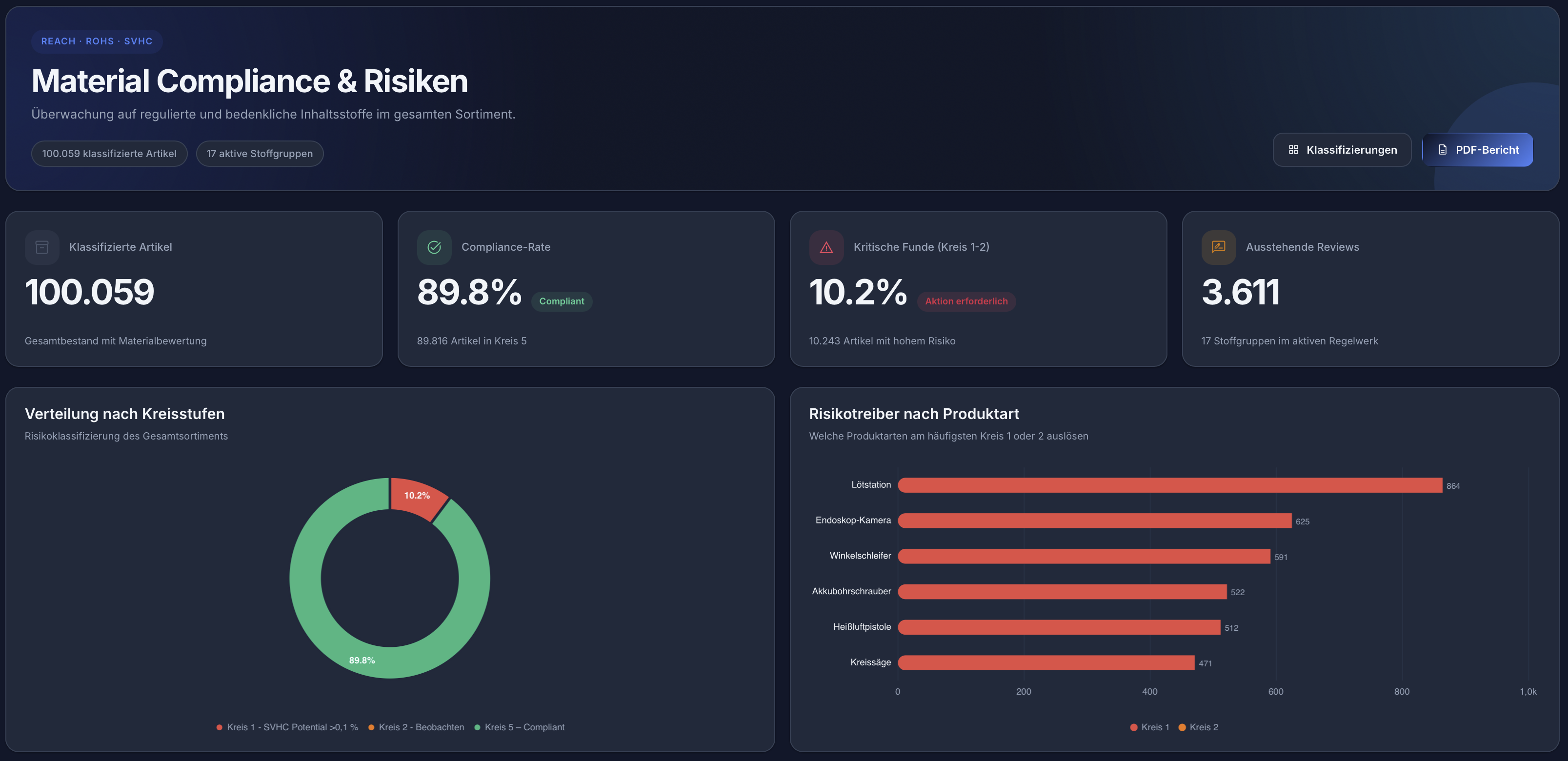
Representation with synthetic demo data for functional illustration – no real product or company data.
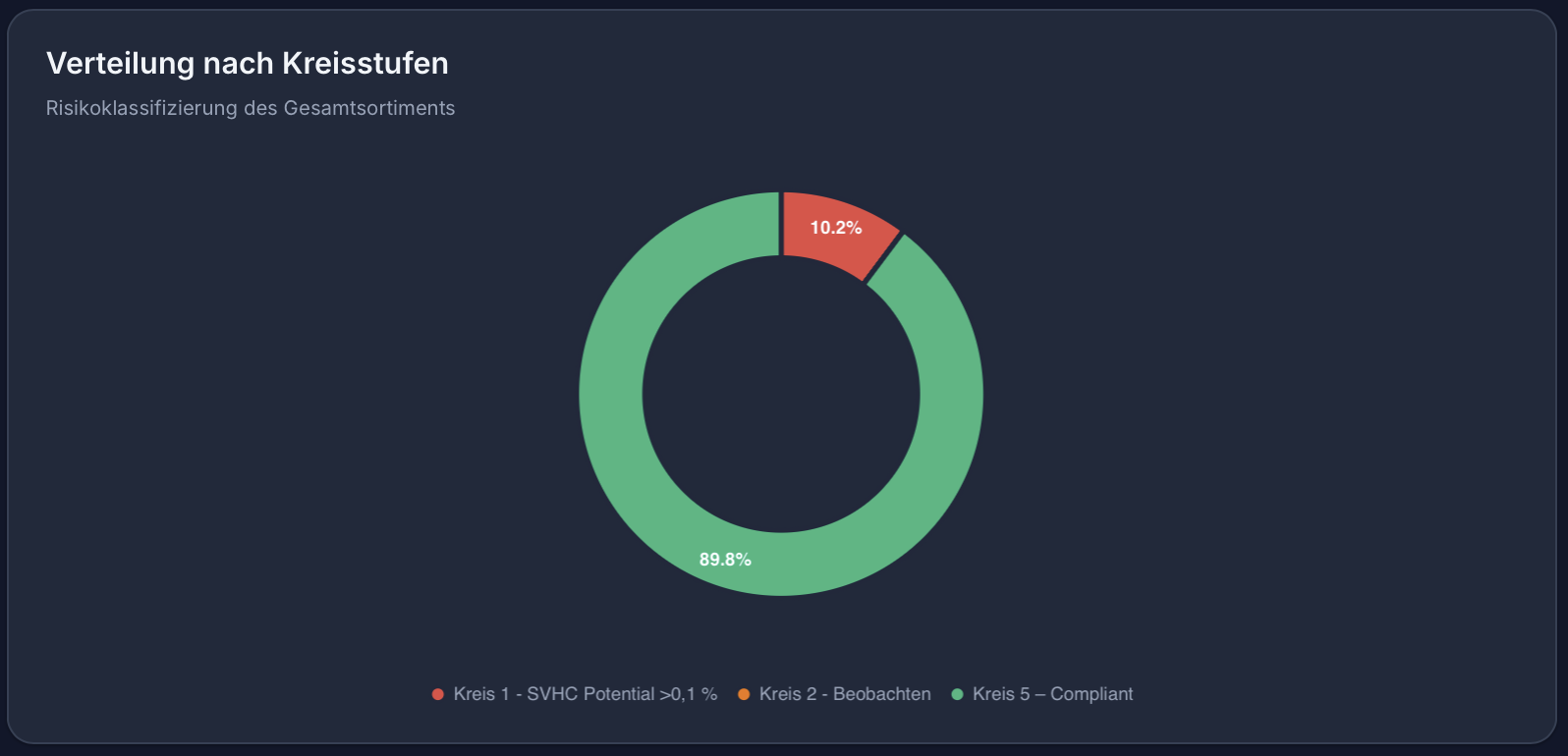
Representation with synthetic demo data for functional illustration – no real product or company data.
Example: WEEE
With the WEEE directive, the operational complexity arising from the multidimensionality of the topic is also often underestimated.
In everyday business, there is often initially just the product. However, regulatorily, this quickly becomes a series of classification questions:
- Is the product within scope in the respective market?
- Which category is appropriate?
- Which national assignment is required?
- Where is the classification stable, and where is it borderline?
As soon as multiple markets are affected, the requirements increase significantly. It is no longer enough to make a decision once. Instead, what becomes decisive is how this decision is documented, checked, corrected if necessary, and transferred to similar cases.
A good internal web application creates consistency here:
- it bundles relevant product information
- it makes differences between markets visible
- it flags uncertain or review-required cases
- it records corrections permanently
- it prevents the same classification from being started from scratch every time
This is a crucial point, especially for medium-sized companies. There, the problem is not every individual decision, but the repeatability of the decision across many products and configurations.
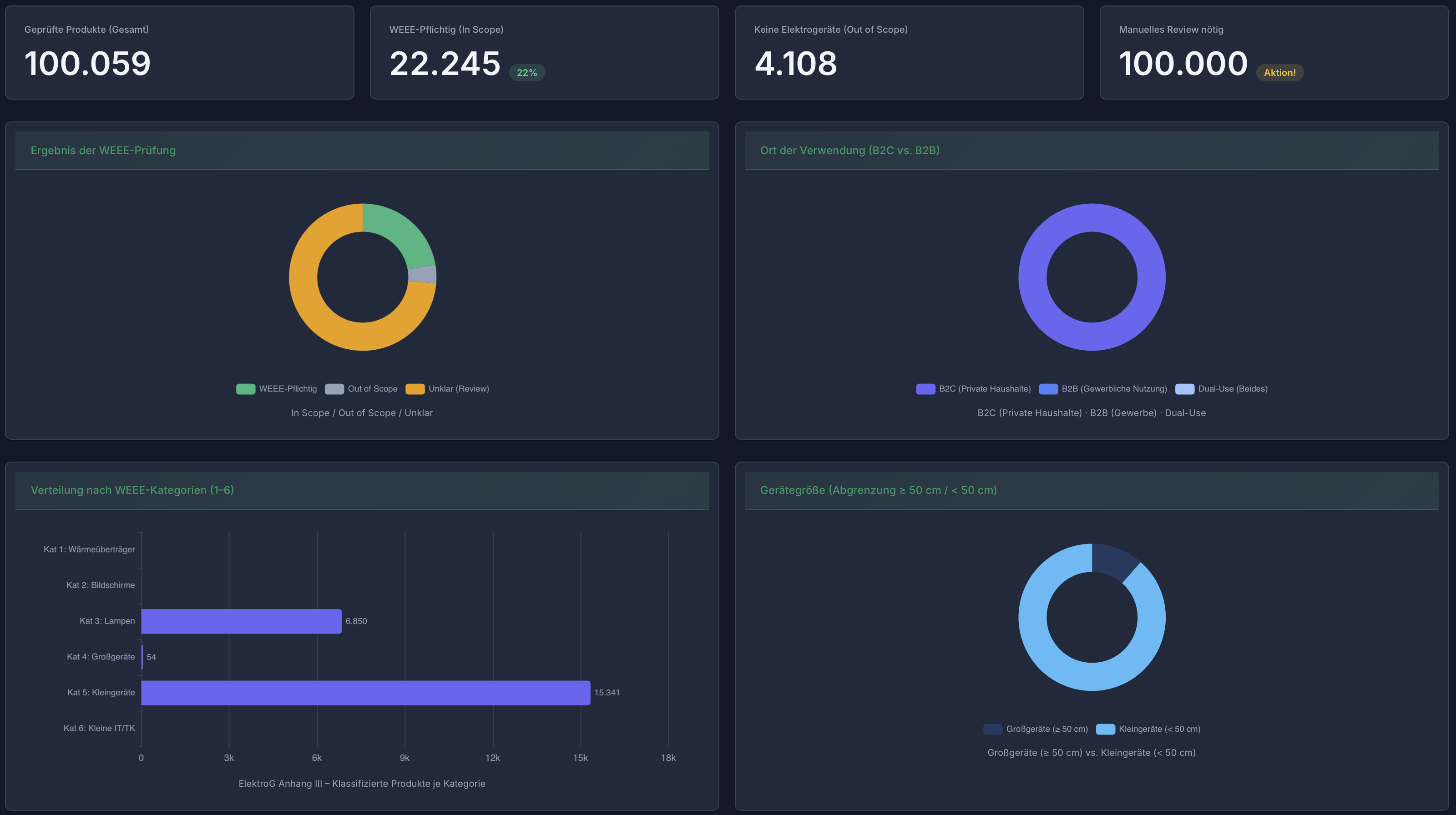
Representation with synthetic demo data for functional illustration – no real product or company data.
Example: Product Carbon Footprint
With the Product Carbon Footprint, the challenge is different once again. How can a plausible and traceable starting point emerge from distributed information?
This is because PCF-relevant information is typically distributed across various areas:
- Material knowledge
- Product data
- Packaging information
- Supplier relationships
- Transport assumptions
Without a systematic approach, this quickly becomes a project with high coordination effort but little reusability.
That is precisely why, for PCF, a perfect calculation is not decisive on day one. What is decisive is first a reliable structure:
- Which data is already available?
- Which assumptions are permissible or at least transparent?
- Where are there identifiable gaps?
- Which values are already highly reliable?
- Which results need to be refined later?
A suitable software solution creates transparency in this environment. It helps to merge information, make calculation logics traceable, and clearly flag uncertainties. This turns PCF from a diffuse future topic into a practically manageable task.
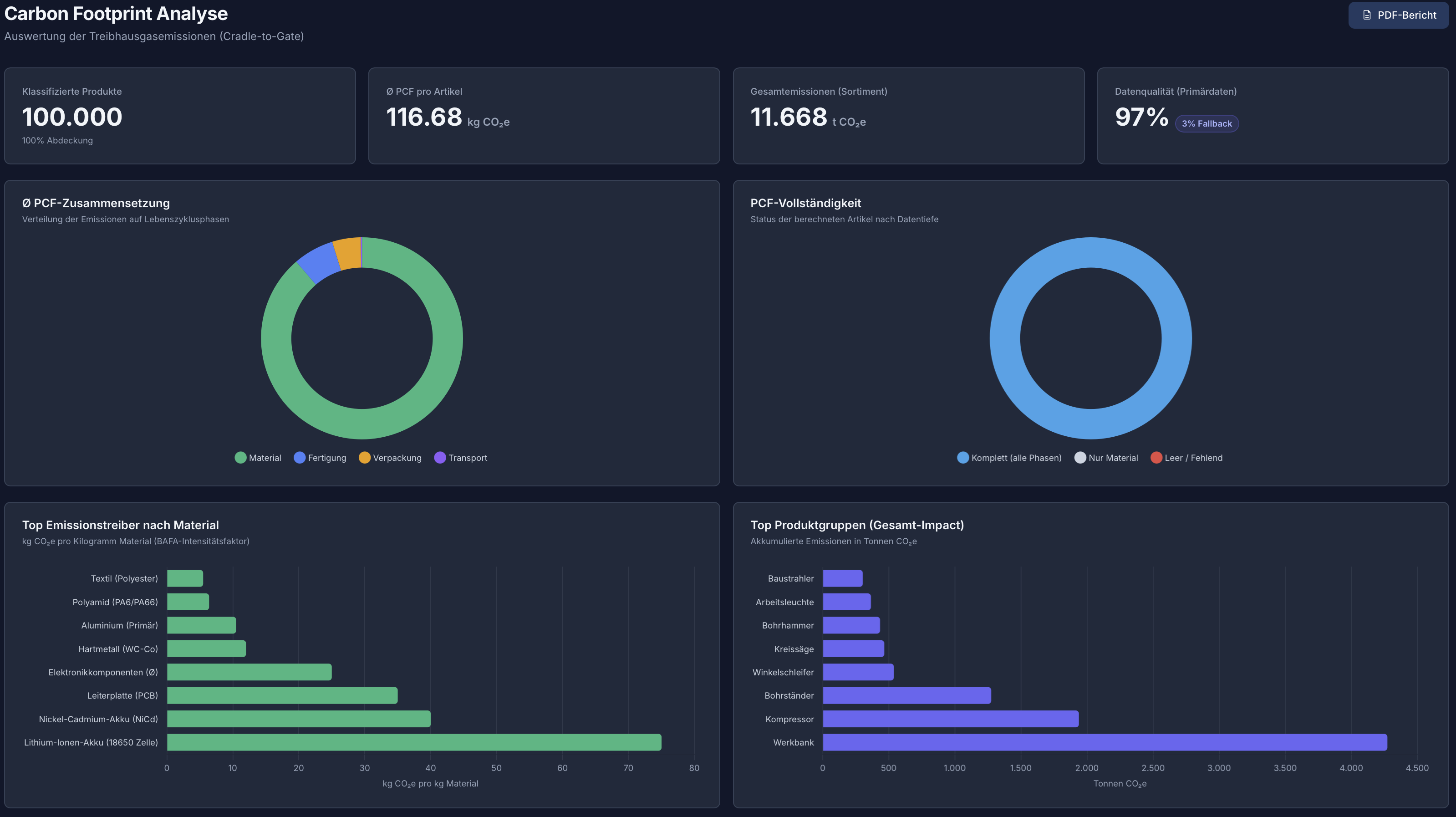
Representation with synthetic demo data for functional illustration – no real product or company data.
What such software should corely achieve
When discussing solutions in this field, one should not describe the benefit too technically. For companies, it is not decisive how a system is built internally. What matters is whether it creates the right working logic.
Therefore, a good solution should primarily achieve the following:
- Make relevant product information centrally accessible
- Derive regulatory indications in a structured manner
- Prioritize risks instead of just collecting data
- Separate clear cases from review cases
- Document decisions in a traceable way
- Enable re-evaluations when lists, markets, or requirements change
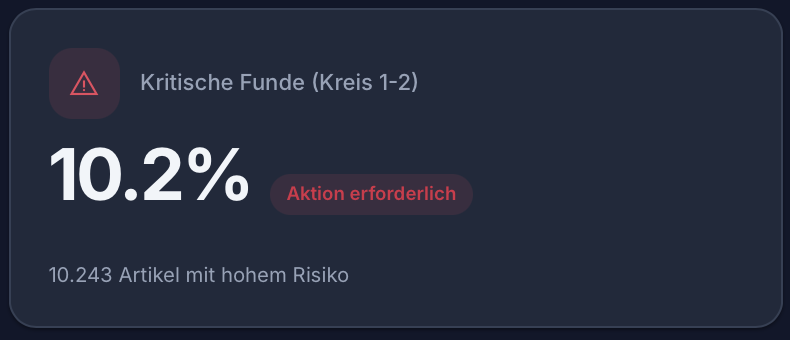
Representation with synthetic demo data for functional illustration – no real product or company data.
This may sound unexciting, but in practice, it is the decisive difference between improvised processing and controllable compliance.
Why such solutions are particularly interesting for SMEs
Large companies can often absorb complexity through personnel specialization, additional tools, and external project structures. In SMEs, this is only possible to a limited extent. There, the same task must be managed with significantly fewer resources.
This is exactly why a particularly high benefit arises here:
- Specialist resources are used more targetedly
- Knowledge does not get stuck with individuals or in email threads
- Existing data becomes more usable
- Inquiries can be answered more structurally
- Regulatory changes do not lead to a complete restart every time
Above all, it creates something that is initially lacking in many companies: a common picture of the inventory.
And it is precisely this common picture that is often the prerequisite for management, compliance, purchasing, and product responsibility to not work side-by-side, but to decide on the same basis.
What such a solution deliberately does not promise
As important as the potential is, so important is a realistic set of expectations.
Software of this kind replaces neither professional judgment nor supplier communication nor legal responsibility. It does not automatically answer every borderline question and does not turn incomplete data into absolute certainty.
However, what it can very well do is often more decisive in practice:
- it reduces manual repetitive work
- it makes risks visible earlier
- it connects similar cases with one another
- it creates traceability
- it makes regulatory topics manageable across the entire product range
The value, therefore, does not lie in a supposedly perfect automation. The value lies in the structured translation of complex requirements into a reliable work process.
Conclusion
Product compliance in SMEs is today much more than just processing individual technical questions. It has become a systemic issue because regulatory requirements, product data, and market requirements are increasingly interlocking.
REACH, circular economy, and sustainability data show in different ways what this is about: not just knowledge of rules, but the ability to make this knowledge effective within the company in a repeatable, traceable, and scalable way.
This is precisely the point where internal applications become a sensible tool. Not because they make all complexity disappear, but because they give it a form that companies can work with in practice.
And this is likely to be the decisive difference for many medium-sized companies in the coming years: not whether regulatory requirements increase, but whether this leads to permanent overload or to a structured, controllable way of working.